
Manufacturing Mythology
Letting go of the illusion of Disney’s Moana

Since its debut in 2016, Disney’s Moana has grown into a billion-dollar franchise that claims to celebrate Pacific cultures while profiting from them. Positioned as a culturally respectful tribute, the franchise has won widespread acclaim particularly among audiences hungry for Indigenous representation from the Pacific. But beneath the glossy animation, catchy music, and carefully marketed consultation lies a deeper, more troubling story. This essay interrogates the myth-making machine behind Moana, exploring how Disney selectively curates Pacific cultures for global consumption while reinforcing harmful erasures, especially of Melanesian and Micronesian communities. It questions the power dynamics of representation, the politics of consultation, and the commodification of Indigenous knowledge, ultimately urging Pacific peoples to reclaim the narrative and imagine futures beyond Hollywood’s gaze.
Becoming a billion dollar franchise
For nearly a decade, Disney’s Moana franchise has embedded itself into Pacific households, a pop-cultural mainstay thanks to its billion-dollar success. Since its 2016 theatrical release, Moana has soared on Disney+, surpassing a billion streams in 2023 alone. Following this triumph, Disney initially planned a follow up to the first film as a Moana TV series for Disney+, only for CEO Bob Iger to announce in early 2024 that the series would instead become a feature film. Moana 2 premiered worldwide in November 2024, with a live-action remake set for 2026. This relentless expansion is part of Disney’s strategy to double down on its most profitable intellectual properties. Meanwhile, toy giants Mattel and Hasbro have flooded the market with Moana-themed merchandise, ensuring the character remains a lucrative household name.
According to Variety, Moana 2 wasn’t just one of 2024’s biggest films; it officially joined the billion-dollar club, raking in $460 million domestically and $598 million internationally as of January 2025. With only 56 films ever reaching this milestone, Disney dominates the billion-dollar blockbuster arena, producing 60% of the highest-grossing films in history. But what does it cost to make a billion-dollar film? Moana had a budget of $150–175 million, while its sequel came in at $150 million—not including the additional $100 million Disney spent on a worldwide promotional campaign curated by Lylle Breier, EVP of Partnerships, Promotions, Synergy & Events. The marketing push was both impressive and nauseating.
Curiously, although for most of us Oceania Disney’s Moana is well known name in Pacific houses that’s not the case in Europe. In most European markets, she’s known as Vaiana because “Moana” is a legally restricted name. Disney co-director John Musker rationalized this as a minor adjustment, stating, “Given that ‘Vai’ means ‘water’ and ‘Moana’ means ‘ocean,’ the sense is ultimately the same.” But why is it a legally restricted name? SlashFilm speculates the renaming wasn’t just a trademark issue but also a strategic move to avoid Google results associating Moana with Italian porn star Moana Pozzi. This oversimplified equation of Vai and Moana reflects the broader pattern of reducing Pacific knowledge into digestible, marketable fragments.
Purchasing Paradise: Putting a price on Cultural Knowledge
In his essay, The New South Pacific Society, Professor Epeli Hau’ofa speaks to the significant development of Pacific Islanders becoming highly trained specialists as a by-product of Australia and New Zealand’s single economy, increasing the amount of consultants within the Pacific region. In particular he highlights how,
“…island consultants are becoming more effective for the cause of capitalist development than their non-Islander counterparts. The co-option of island intellectuals into the system is a politically judicious; it gives the appearance of locations and a fair division of labour, not mention lucre, while at the same time promoting development towards ever greater regionalism".”
Disney claims that in 2011, directors Ron Clements and John Musker embarked on a research trip across the Pacific, consulting anthropologists, historians, wayfinders, and cultural experts from Fiji, Mo’orea, Sāmoa, Tahiti, and unnamed “other islands.” That last part - the vagueness of “other islands” - is telling to those of us who belong to nations usually relegated to “other”. Allegedly after this trip, Disney formed the Oceanic Cultural Trust, a team of Pacific Islander scholars and artists meant to ensure accurate representation. But Disney’s marketing only pushes the names of three members: Kalikolehua Hurley (Hawai‘i), Lāiana Kanoa-Wong (Hawai‘i), and Nainoa Thompson (Hawai‘i). The full membership remains opaque to anyone searching their website, as it’s not obvious who is part of the trust for both films, and where in the Pacific region the advisors come from. Names do appear after some serious googling, but only the film credits will give you a full list of names. Below you will find the names from the Oceanic Story Trust of Moana. Everyone is listed below exactly as they are credited in the films:
● Community Relations Manager: Kalikolehua Hurley
● Story and Cultural Consultants: Dionne Fonoti (Sāmoa), Francis Murphy (Mo’orea), Hinano murphy (Mo’orea), Korova Community (Fiji), Layne Hannemann (California), Dr Paul Geraghty (Fiji), Su’a Peter Sulu’ape (Sāmoa), Tautala Asaua (Sāmoa), Tiana Nonosina Liufau (California), Dr Vilsoni Hereniko (Fiji/Hawai’i) and Yves “Papa Mape” Tehihotaata
And the Oceanic Cultural Trust of Moana 2:
● Production coordinators, cultural: Holly Nellis, Stephanie Lopez Marfin
● Consultants: Millicent Ka’ameni-Kuper Barty, Dr Dionne Fonoti, Lehua Kamalu, Laiana Kanoa-Wong, Tiana Nonosina Liufau, Dr Grant Muāgututi’a, Francis Murphy, Hinano Murphy, Thomas Raffipy, Su’a Peter Sulu’ape, Tweedie Waititi
● Animation reference choreographer: Tiana Nonosina Liufau
Generally speaking it is common practice to write someone’s ancestral island/tribal/village connections after their name in credits. It’s curious that for Moana there was no clear rule - the Oceanic Story Trust for Moana credits signalled either where someone was from ancestrally or where they lived, but the Oceanic Cultural Trust for Moana 2 doesn’t. Beneath the Oceanic Cultural Trust credits in Moana 2 is “With a note of “Special thank you to Nainoa Thompson for his commitment to the dignity, integrity and continuity of traditional Pacific navigation”. In 2022, Nainoa Thompson (Hawai’i) of Polynesian Voyaging Society was accused of cultural appropriation and theft of Micronesian navigation knowledge by Yapese Grand Master Navigator, Ali Haleyalur, the half-brother of Grand Master Navigator Pius Mau Piauilug (Caroline Islands) who is credited with teaching Hawaiians – specifically Nainoa Thompson - voyaging as part of their traditional wayfinding revival. A recent social media post by Filipino-Pohpeian scholar and writer Vincente Diaz, highlights how often Micronesian navigation and Polynesian wayfinding are conflated and this is perpetuated by Disney’s Moana, media, and tourism.
Michel Mulipola (Sāmoa) shares in his review of the Moana 2 film that despite his extensive cultural consultancy and language work on the tv series and film and with Disney staff, he was only credited as a story artist. Mulipola speaks of the lack of acknowledgement of his cultural consultation contributions with distaste, “Surprised but not surprised that we weren’t credited for all the work because we weren’t part of the exalted Oceanic Story Trust.” Given his claims that he taught a basic gagana Sāmoa lesson with over 100 Disney employees because no one could say Motufetū correctly, and he even recorded pronunciations of Gagana Sāmoa for Disney’s database it tracks that Mulipola feels hard done by. This speaks to the cultural load artists of Pacific descent carry within the work environment, with little to no recognition or remuneration for that work and the elitism or preferential treatment for who constitutes a knowledge holder through the establishments of trusts or consultation bodies. Interestingly, on the Island Fever podcast, Fresh Takes: Moana 2 episode, Kristian Fanene Schmidt (Sāmoa) also mentions that he worked on the film as a consultant despite not appearing in the credits.
Preferencing knowledge systems and knowledge holders
In 2016, The Fiji Times covered Disney’s visit to Korova, a village in Suva, Fiji, where they met with Master Navigator Jiujiua Bera and his brother Semiti Cama. The people of Korova migrated from their village Korotolu on the island of Moce in the Province of Lau. It is said that the people of Moce are the best sailors in Lau, and it is known that Lauans are not only the best traditional navigators in Fiji but the keepers of knowledge around building canoes as Mataisau (Traditional role of carpenters that exist within the i tutu vakaVanua system in Fiji). Korova was a key destination of research for Disney. Remnants of the canoe that was used to make this final voyage from Moce to Suva are still found on the shores of Korova. In Matilda Simmons recount for the Fiji Times, she highlighted the exchange between Master Navigator Jiujiua Bera, his older brother Semiti Cama, and the Disney team dated all the way back to 2002 (Far earlier than when Disney states Clements and Musk began their research in the Pacific).
These elders (credited in the films as the Korova Community) were happy to share their knowledge on traditional wayfinding because in the Fijian way, “It is free to be given. We believe if we sell our knowledge, the mana associated with it would be lost…However the person dealing with this should have the foresight to know for it to benefit the recipients.” Disney reportedly offered them an envelope containing $300USD as a traditional sevusevu gift, later paying their family $500USD per consultation for their cultural knowledge. This figure of Disney paying $500USD per consultation to an entire community is astounding and heartbreaking when you consider not only that Moana is a billion dollar franchise, and that the actors were speculated to be paid thousands-millions of dollars (plus royalties) but when you consider the recent development that animator Buck Woodall is suing Disney for $10 billion dollars plus 2.5% of gross revenue of the films and related products over copyright infringement. Woodall claims that the Moana film franchise is a direct rip off a project he pitched and developed called ‘Bucky’ (which also wasn’t registered until 2003 - after Disney began visiting Korova village), and despite being born in Hawai’i Woodall has not self-identified as having Indigenous Pacific heritage nor consulting with Pacific peoples to produce ‘Bucky’. The whiteness of entitlement of Buck sets into motion many important questions around story sovereignty and Indigenous Cultural and Intellectual Property (ICIP). One of the most painful ironies of this story is that if Woodall were to win his case, it sets precedent for Indigenous peoples from the Pacific to seek compensation against Disney and perhaps Woodall for the use of their cultural practices, knowledge and motifs in the Moana franchise. For now, Woodall has lost his case against Disney for Moana, but his lawsuit pertaining to Moana 2 still has legs.
Following the consultations with Disney, Mr Bera and his family were made recipients of a trust under the Pacific Blue Foundation, an American and Fijian charity, which was intended to fund the Drua building business they hoped to begin from the earnings of consulting for Moana. According to the 2017 Pacific Blue Foundation report, Disney donated funds to the University of the South Pacific around 2015 as a token of their appreciation for help towards the Moana film which was used to build a Drua named ‘Te Fiti” under Mr Cama’s guidance.
It’s remains unclear why only Nainoa Thompson, Kalikolehua Hurley and Lāiana Kanoa-Wong are publicly celebrated by Disney’s marketing as the key members of the Oceanic Cultural Trust and leading advisors. It also remains unclear why Hawai’ian Wayfinding is considered the foundation of this story, despite consultations with Fijian knowledge holders and the extensive un-broken lineage of Carolinian navigation.
Following and fracturing the logic of Moana’s world
In this new adventure for Moana, set three years after the original, we meet her at the top of a new island where she drops into the forest and discovers what is presumed to be Lapita pottery with the help of Heihei, her chicken sidekick. This affirmation of other human existence beyond Motunui is the wind Moana needs behind her sails to sail beyond the reef, and she sets of home to share the news with her village. After being bestowed the title of Tautai by her father, Moana receives a message from her ancestor, Tautai Vasa, that she must sail beyond the reef to re-unite all the people of the Ocean who were separated by an evil deity known as Nalo. On her journey to re-unite the Ocean, Moana meets the Kakamora (Again), a giant clam and a bat deity called Matangi who present obstacles to her journey.
Upon landing on the shores of her village, Moana nonchalantly tosses the pottery to her baby sister, Simea as a present. It was personally striking to witness the pottery merely being used as a plot device that was discarded so quickly. For me, this was the first of many puzzling demonstrations of disconnection from the legacies of migration in Disney’s story work. The Lapita peoples are considered to be ancestors of Indigenous Pacific peoples, a seafaring culture that connected Oceania to our kin in Taiwan. The name Lapita has it’s origins in Kanaky after an excavation in 1952, but the first remnants of Lapita pottery were discovered in Watom Island in Papua new Guinea in 1909, and today this pottery making style still exists. In Fiji alone there is no less than 14 villages that practice this ancestral method of pottery making.
Migration across the Pacific happened across the Ocean thousands of years ago. On the so-called continent of Australia, we know our kin have existed there for 60,000 years. Around 45,000 years ago people crossed from the continent into northern Melanesia. It was only in the last 3000 years – around the time when Moana is set – that voyagers began to venture beyond there, reaching eastern Melanesia and Polynesia with Aotearoa being the final island to be settled in Oceania after it’s discovery by Tahitian master navigator, Kupe.
In this new story, Moana decides to set out and sail beyond the reef to connect the islands of the Ocean after a visit from her ancestor, Tautai Vasa. Michel Mulipola shares in his review that this wasn’t the original story, however,
“In the first cut of the project I saw when I started, they had Moana searching for new islands to expand Motonui’s empire. I said that that was essentially a colonial mission, and that after the canon set by the first film where Motunui is set off from the rest of the Moana for a thousand years Moana’s new mission should be searching and reconnection with her people from around the ocean. That feedback totally changed Moana’s mission for the film.”
So the story went from Moana colonising the Ocean to saving it. As we watch Moana talk to her family and village about her decision to go beyond the reef, new characters emerge – Moni, Loto and Kele – and not long after returning to Motunui and discovering the pottery, the title of Tautai is bestowed upon Moana by her family in a non-descript ceremony where she deploys Pan-Pacific choreography in a battle against village kids, choreographed by Oceanic Cultural Trust member Tiana Liufau. In the Island Fever podcast Tia Kaiulani Kanaeholo shares that she felt Moana being called to action as a reflection of her “sacrifice” for her community was founded on the idea that the writer’s were highlighting how community is an important part of Pacific culture. This opinion is in direct opposition to Michel Mulipola’s critique that after three years Moana remains the only tautai skilled enough and brave enough to sail beyond the reef. Not only has she not shared her navigation skills with her community, she takes an untrained crew that Mulipola refers to as Non Playable Character’s or NPC (one of whom - Kele - spends most of the story below the deck) to beat the villain and re-unite the Pacific.
When we first meet Moana she is 13 years old. In the sequel, she is 16 years old with a baby sister in tow. Could anyone – regardless of gender – really become a tautai at such a young age? In Tokelau, to be a tautai is not just to be a navigator it is to be a master fisherman. A tautai is an expert in reading na mahina ma tona whetū (the stars), na Mahina whaka Tokelau (the Tokelauan lunar calendar), nā tauga ote matagi (the moon phases) and nā matāmatagi o Tokelau (the wind directions). A tautai knows which fish are in abundance and in which part of the sea based on where the moon rises above the sea. You earn that role through years on the water, guided by elders. These skills are born out of necessity for survival on islands that are subsistent. Matagi’s character, with the ability to manipulate her namesake - the winds - was a lost opportunity to highlight the many skills required to be a tautai – with Disney choosing to push the narrative that wayfinding is mostly about reading stars. Though this is a Sāmoan coded “Pan-Pacific” story, I think it’s fair to propose this from a Tokelauan worldview given that the original music was written by Tokelauan and Tuvaluan band, Te Vaka and that a lot of the language of Motunui in the film and soundtrack is gagana Tokelau.
Despite the fact that sharing food together is an important value of Pacific community building and maintenance, we don’t see Moana fishing, farming nor breaking bread and eating with her community or crew once. Even though there’s a whole lot of low hanging coconut jokes, we don’t even see Moana crack open a coconut once. One of the greatest tragedies of this film is that despite having a farmer with crops below deck, Moana sailed the sea and conquered Nalo on an empty stomach. Couldn’t be me, sis.
Manufacturing Monsters
At first the introduction of Moana 2’s villain, Nalo, feels like a thinly veiled metaphor for colonialism, white supremacy, and the Pacific’s historical fragmentation as a result of this until you wait for the credits at the end and you see that Nalo is Black. Villains Wiki describes Nalo as a “misanthropic, power-hungry storm god who wants to destroy humanity by preventing voyaging.” In other words, he’s the force that keeps Oceanic peoples divided. This could have been a powerful critique of imperial agendas in Oceania and for a moment I briefly thought the visualisation of the many islands connected by Motufetū mirroring Te Wheke meant that it might be the villain but instead, Nalo is cast as the quintessential evil Melanesian - a caricature of Blackness in the Pacific – the scapegoat of imperialism. Professor Epeli Hau’ofa spoke on this, almost predicting the creation of Nalo in the early 2000s,
“With often lighter skinned Polynesian and Micronesian life in the Pacific was accorded a higher value than the darker ‘Melanesian’ Pacific, where the “pseudo-evolutionary comparison between the ‘developed’ Polynesian polities and the ‘underdeveloped’ Melanesian ones” functioned to divide our collective peoples against each other (Hau’ofa, 2008, p.6).
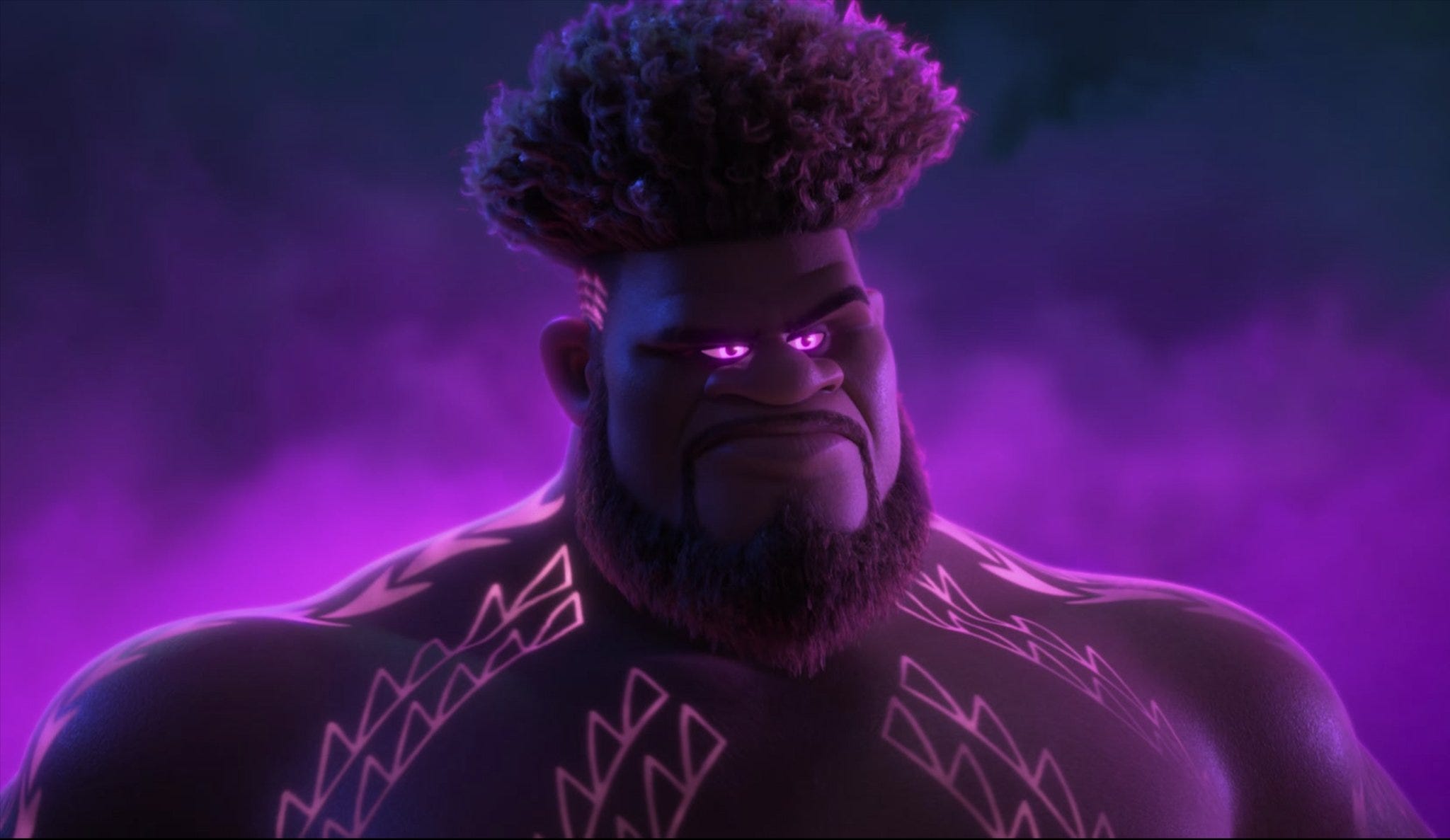
Image: DisneyWiki
West Papuan scholar Dr Nathan Rew’s thesis, Aqua Nullius and Frames of Wara in a Black Oceania, interrogates the racialised exclusions within Pacific identity as important to confront in order to imagine a New Oceania. Rew highlights how Blackness is systematically erased from dominant Pacific narratives, particularly in how colonial-capitalist structures weaponise the Ocean to exclude Melanesia and West Papua.
“In this, even within the Pacific, amongst our own peoples, the logics of colonial-capitalism permeate our relationalities, denying us our right to belong. Central to this, as will be explored in the third section of this thesis, is the prevalence of white supremacy as the organising logic of racialisation in the Pacific as part of the system of colonial-capitalism”. (Rew, 2021)
This aligns with the way Moana 2 positions Nalo as the sole figure responsible for Oceanic disunity rather than the colonial forces that created these divisions. A peculiar, but on brand, re-enforcement of this was that the one Melanesian character in the entire Moana franchise that had spoken lines, was not even voiced by a Melanesian actor but by Sāmoan actor, comedian and radio host, Tofiga Fepulea’i.
For many Polynesians, Tofiga’s casting was celebrated. On the Puāwai podcast, one host reflected excitedly:
“You’ll notice that the voice actor for Nalo, the thunder God, is Tofiga. And even though he had a two second appearance at the end of the film that small screen time it brings a lot of happy times…just knowing that you know one of our OGs is out there representing our community it brings a lot of smiles to our faces.”
The right to belong, the call to be seen and recognised as human and of Oceania is sadly far too familiar for those perpetually othered and excluded from the Pacific narrative across Melanesia, Micronesia and French Polynesia. The contribution of Melanesia to Pacific existence cannot be understated. Not only does Melanesia represent the most language diversity in all of Oceania (Papua New Guinea alone has 25% of the entire world’s languages), but Melanesians are the highest population of Indigenous peoples in the Pacific region.
Anti-Blackness in Polynesian communities and leadership is increasingly well documented over the years. Evidence ranges from how diasporic Polynesians still arguing whether or not they can say the N word to the resistance from the Ministry of Pacific Peoples in Aotearoa to include Solomon Islands, Papua New Guinea and Vanuatu in the Pacific language weeks. So am I surprised that people not only refused to agree the film was anti-Black or that most didn’t even register the racism? Sadly, yes – because I had hoped there had been growth since 2020.
The reality of Black Oceania is that many of us experience being “the wrong kind of Black” as Dr Rew puts it (2025). In the latest issue of The Funambulist, Black Indigineities, in conversation with Zimbabwean nyanduri, healer, academic and writer Makanaka Tuwe, Dr Rew puts it as “acknowledging that race is a social construct – there are forms of black being that are preferable to others according to our white supremacist world…”
Despite the outrage I felt at the time watching this, retrospectively thinking about the casting of Nalo, it completely makes sense that a non-Melanesian was cast in this role. It followed the logic of the entire film. Nevertheless, the horrifying reveal in the credits felt like a punch in the face. Nalo looks just like my Ta Lailai, my son’s Kuku, my best friend’s husband - he looks like so many kind, warm and generous Melanesian men that are excellent role models in my children’s lives. It was this moment of revelation after the credits, when everyone had left the cinema and it was just my friend and I, that liberated me from the illusion that Disney is trying to produce a culturally sensitive film, and pushed me to see it for the myth-manufacturing factory that it is.
Nalo wasn’t an isolated case of “uh oh”. According to Kristian Schmidt from the Island Fever podcast, the Kakamora have a redemption arc in Moana 2 due to the Solomon Islands community coming forward and calling out the way they were portrayed in Moana. Schmidt frames misrepresentation of the Kakamora as a great opportunity to learn rather than as an example of why this should not have happened in the first place. Considering Disney’s research began in 2002, 14 years was enough time to consult with Solomon Islander communities about the appropriate use of the Kakamora – if at all.
While we’re on the Kakamora, I want to briefly turn your attention to the giant clam. Palau is home to eight of the ten known species of giant clams in the world, which explains it’s importance to not only biodiversity but creation stories of Palau. Capable of living up to 100 years, giant clams are hermaphrodites, producing both eggs and sperm capable of releasing 500 million eggs in one go. Latmikaik is the name given to the giant clam from which Palauans believe is responsible for birthing humans. Across the seas in Fiji, giant clams are also an important part of sea biodiversity. Cosmologically, two giant clams are believed to guard the Katonimana, a magical box that is buried in the sea between Likuliku and Mana islands. It found it’s way there after slipping overboard from a double hulled canoe of Tui Lutunasobasoba, a founding ancestor of Indigenous Fijians. In the logic of Moana’s world, the giant clam serves as both a prison for Matangi, and a barrier alongside Nalo’s curse preventing anyone from reaching Motufetū and breaking it’s curse. If timeline’s mattered in the world of Moana, the “monstrous minion” of Nalo that stops the Kakamora from returning home is not old enough to be real given that the Kakamora would have been sailing the sea for at least 1000 years and Giant Clams live up to 100 years. But whose counting? Regardless of the temporal logic, it’s a shame to see an important ancestor of Palauans villanised as a way to course correct the anti-Black narrative of Solomon Islander creatures.
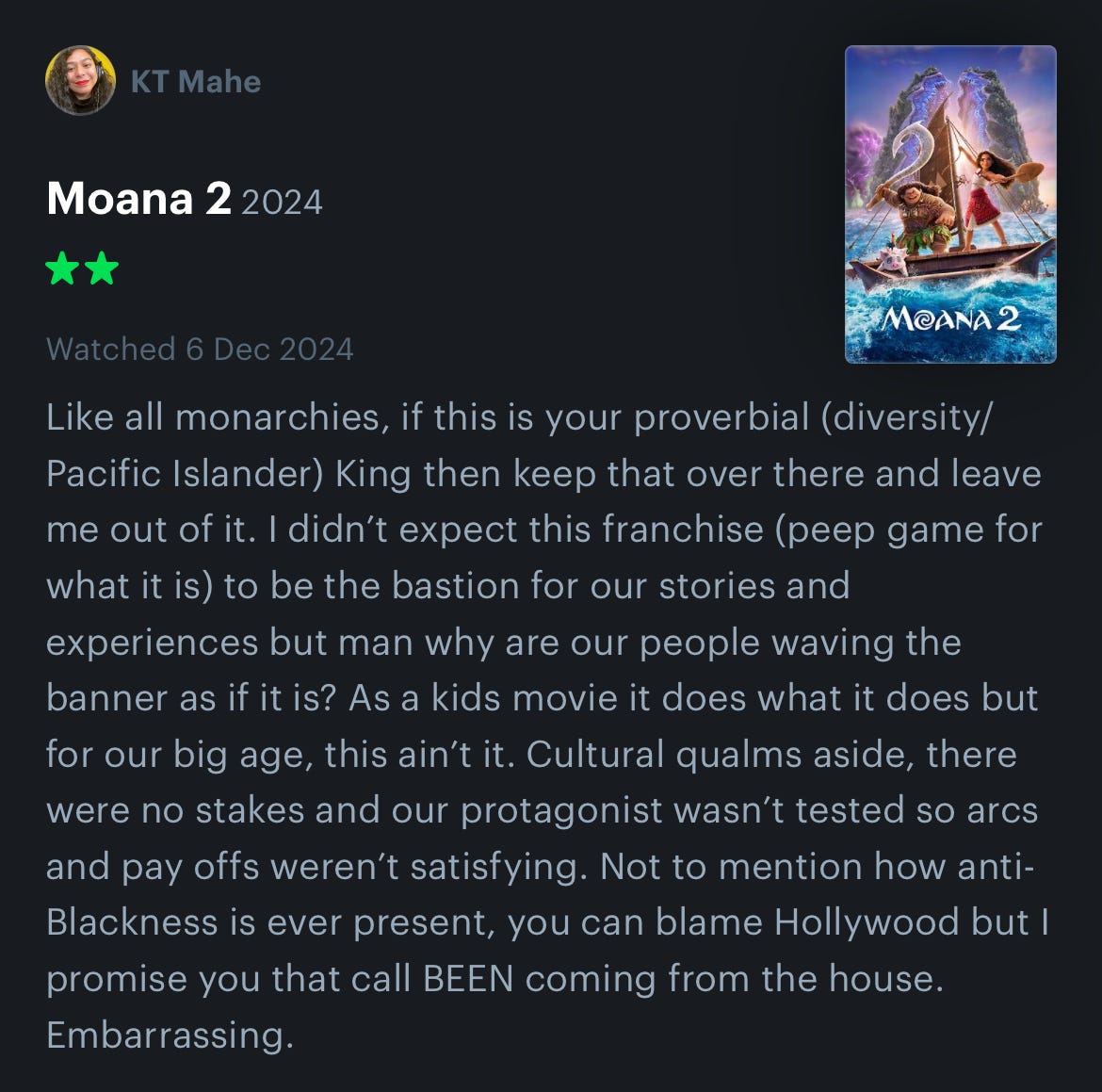
I have to look at this film and ask myself: what’s the truth behind this film directed by two Sāmoans? Did the Pacific Islanders who were writers, directors, consultants and story artists truly have influence, or were they simply there for optics? And if they did have the influence they proclaim, why were they not just complicit in the film’s perpetuation of anti-Blackness and historical erasure of Melanesians and Micronesians but proud of it? As KT Mahe from For Your Reference podcast put it, “you can blame Hollywood but I promise you the call BEEN coming from the house.” or in the words of Kanaka Maoli filmmaker Anne Keala Kelly,
“What the capital F were they thinking when they helped Disney strip-mine our cultures for the sole purpose of making a profit?”
For all of you reading this thinking, "Shaddup, it's just a kids' movie". Not only is that a conveniently cute excuse to deflect criticism of cultural appropriation and misrepresentation, it’s patronising to children. Children’s media shapes how young minds understand themselves and their place in the world. When Pacific children see their skin colour villanised, sacred cultural practices reduced to catchy musical numbers, or watch their ancestral artefacts treated as disposable plot devices, they internalise these devaluations. Even more troubling is when Pacific adults validated these concerns with "at least our kids see themselves on screen." This acceptance of colonial coloured crumbs from Hollywood's wonky table teaches our children that their cultural heritage is only valuable when filtered through a Western lens. Every time we tell our youth to be grateful for Disney's version of their identity as an authentic representation of Pacific culture, we perpetuate violence - one that teaches them to expect and accept the commodification of their heritage.
Nalo, the only Black character on-screen with dialogue is the villain, Kakamora (previously villanised) are mis-represented, the darkest supporting character, Matangi, is not only vililanised (temporarily) but enslaved by Nalo, and Lapita pottery is tossed away as insignificant - all significant signals of anti-Blackness in Moana 2.
Cultural inconsistencies
If Moana attempted to obscure its Sāmoan influences, its sequel fully embraces them, featuring an ‘ava ceremony as a pivotal moment. Co-director David Derrick Jr. (Sāmoa) affirms this as intentional, “Ava is used in ceremonies all over the Pacific, but we wanted the one in the film to reflect a distinctly Samoan perspective”. This is a stark contrast to remarks from Oceanic Cultural Trust advisor Paul Geraghty that for the first Moana film the Trust intentionally steered the narrative away from being Samoan centric. Geraghty who is of Irish descent and was raised in England, is an Adjunct Associate Professor in Linguistics at the University of the South Pacific. “We had to correct that tendency because we didn’t want it to be identified to any particular Polynesian nation,” said Geraghty in the first issue of a 2017 Wansolwara newspaper “So we moved away from Samoa and concentrated on making it look like what any place in Western Polynesia would have looked like some 2000 years ago.” Geraghty is also responsible for suggesting character names such as Sina, for Moana’s grandmother, played by Rachel House (Aotearoa) and Tui, Moana’s father, played by Temuera Morrison (Aotearoa). The name Sina eventually was given to Moana’s mum, played by Nicole Sherzinger (Hawai’i) and her grandmother became Gramma Tala. As well as suggesting the names Te Fiti and Motunui, Geraghty shared with Wansolwara newsletter that he was responsible for leading Disney to the village of Korova. Despite Geraghty’s significant contributions to language in the story of Moana, he is nowhere named in Disney’s publicity about the Oceanic Cultural Trust - perhaps it’s because he does not suit their preferred optics for what a cultural advisor for the story of their Polynesian princess should look like. This inconsistency highlights the franchise’s broader issue: Disney’s approach to Pacific cultures is opportunistic, shifting to fit whatever marketable version of indigeneity best serves its bottom line.
I also wondered why Moana referred to the water throughout the film as Ocean and not…Moana. Despite the use of powerful names for characters such as Tui, Moana, Sina and Matagi in Moana 2, there was clear disconnect in their characters arcs (and the design of their names) from the cultural and historical significance of those names. Chief Tui essentially means Chief Chief (for example). The language logic of this world is at best a conglomerate, and at worst negligent. In all of the reviews I have listened to, not a single reviewer was able to name with confidence the languages that were in the film.
Disney's marketing of Moana carefully crafted an image of cultural sensitivity, positioning the film as a respectful celebration of Pacific heritage. Why?
The reality of this world is that mainstream media perpetuates cultural preference for Polynesians by making Pacific and Polynesian synonymous. That is exactly what Disney produced. A story that looks out to Oceania from a Poly-centric worldview that is heavily Sāmoan coded. By publicly highlighting and pushing the narrative of their consultation with cultural advisors and anthropologists, and specifically the Oceanic Cultural Trust, the studio created a veneer of authenticity that masked the fundamental commodification of Indigenous narrative and erasure of Melanesia and Polynesia. These consultations, while seemingly well-intentioned, often look more like performative checkbox than a genuine commitment to cultural integrity. The advisors become a shield against criticism, allowing Disney to claim cultural bona fides while still fundamentally controlling and simplifying the story through a distinctly Western, commercial lens.
Co-Director, Dana Ledoux (Sāmoa), says “We leaned into what it means to be of the Pacific…Specificity is universal, and other cultures can see themselves in ours because we share so much.” Ledoux shares with Laughing Place. But what does it mean to be of the Pacific today? It’s almost impossible to answer this, for we are as diverse as we are complex.
The original intention of Disney to set Moana 2000 years ago enables them to blur the lines around culturally accuracy. Kristian Schmidt on the Island Fever podcast reflected on this,
“When they explained (Tiana, Laina, Kaliko) – this is the island before we broke off into our respective islands so we are watching the choreography which looks kinda weird to us because this might be the thing that sparked off the haka, or the movement that sparked the first kind of rumblings of whatever. I liked it that way, cuz I could get down with that it doesn’t feel like you’re trying to fit everybody into this thing now... This is the world thousands of years before who we are…”
Okay, so it was set 2000 years ago in a fictional pre-island nations motu - except again, at this point in history, Pacific peoples were actively migrating and settling in Western Polynesia. The directional choice to allow multiple diasporic accents (read: the native accents of the actors) meant that dialectally the cast placed the story between modern-day Hawai’i, America and Aotearoa, New Zealand – except for Rachel House, whose accent had Mid-western Austronesian undertones (As in, she’s the only actor who performed with an accent that wasn’t her own diasporic accent and sounds like what we would recognise in present day as a Polynesian accent).
But if I ignore that I can see Disney’s story team’s justification for the cultural dilution...kind of. But why was the entire cast of lead and supporting roles Polynesian (Oh, except for Heihei who was white. Disney couldn’t find a single Pacific Islander to play a chicken for Moana or Moana 2) Of the Polynesians cast, the cultural diversity spans Aotearoa, Tonga, Hawai’i and Sāmoa. There is no less than 54 countries in Oceania, 24 of those are Polynesian nations, and yet only four Polynesian island ancestries are represented in casting.
Responses from Pacific peoples
The Fresh Takes ‘Hot Takes’ review of Moana 2 from the Island Fever podcast reads mostly as preference towards the narrative choices from co-hosts, Kristian Fanene Schmidt (Sāmoa), Michael Alisa (Sāmoa) and Tia Kaiulani Kanaeholo (Hawai’i).
Beyond other moments I’ve previously shared in this essay, what stayed with me was the multiple unfounded and unsupported claims shared by Michael Alisa such as “There were no maps, it was all chants it was all oratory culture.” I had to re-listen to that part five times to ensure I heard it correctly. No seriously. Not only is this statement outrageous on so many levels, but his co-hosts didn’t step in to correct his erasure of the unbroken lineage of Micronesian navigation in the Carolinian islands, where there are tools like Paafu that are used for navigation but cannot be equated to western tools like maps (Diaz, 2025). If we look at Oceanic history from a western lens, no Indigenous peoples did not have maps as know them. We have not historically flattened geographies as part of navigational practices. But if we look at our history from an Indigenous lens, we understand that oratory culture are spatial and temporal relational systems, utilised alongside other technologies like paafu in the Caroline Islands and cosmological knowledges such as star and wind compasses to navigate. We see these multi-dimensial mapping practices have not only persisted across the Marshall Islands, Palau and Carolinian islands, Tokelau, Fiji, Uvea, Kanaky but they are far more sophisticated than 2D western maps.
Alisa’s claims of erasure went as far as to claim, “Tatau, which was only preserved in Sāmoa, out of all the islands…only Sāmoa preserved it.”, “And now we have the Tongans with the drums, that was only in Tonga. No other island had drums anymore after colonisation. The Tongans shared the drums with everybody… The erasure of multiple Indigenous Pacific lineages in tatau and drumming was shocking to say the least, and was definitely . The definition of preservation is to “maintain (something) in it’s original or existing state.” (Oxford Languages). The rhetoric around the language of preservation is just as dangerous as the language of what constitutes “traditional” vs contemporary Pacific arts and cultural practices. In 2016 Dr Sean Mallon (Sāmoa) wrote a blog titled “why we should beware of the word traditional’, about why scholar and writer Albert Wendt (Sāmoa) requested that Te Papa Tongarewa, the national museum of Aotearoa NZ, abandon the use of terms like ‘traditional art’ in their labels and display signange. In Wendt’s groundbreaking essay, Towards a New Oceania, he argued that “There is no state of cultural purity (or perfect state of cultural goodness)’, as Mallon highlights, Wendt “warned of stagnation, an ‘invitation for a culture to choke in it’s own bloody odour, juices and excreta’.
Speaking specifically to Alisa’s shocking claims, tatau in Sāmoa has two origin stories, both that gafa to Fiti – one referring to Fiti being the transliteration of the Fiji Islands and twin sisters who brought the tattooing practice of veiqia to Sāmoa. The second referring to the Manu’a Islands from a village called Fiti’uta. In it’s 3000 year history, tatau has experienced shifts in materials, tools and interpretations both on island and in diaspora. Even within the islands of Sāmoa, the cultural practice of tatau has outrun definitions of “preservation” and “traditional” by remaining a current practice. As for percussion across the Pacific, it remains the cultural heartbeat of many island nations, and we see across the Ocean how this is upheld through multiple variations on a theme of the same drums. The pāte (Cook Islands, Sāmoa, Tokelau, Tuvalu) and it’s tuakana like the Lali (Fiji), the Garamut (Papua New Guinea), Kove and Atingting Kon (Vanuatu) or Lemut (Zenadth Kes) are an example of how drumming performance practices have not only transformed but sustained over thousands of years. In Tokelau, our materials have transformed our drumming practice for example the pāte historically played during whatele is now commonly played alongside or replaced by the apa, a drum made from a large biscuit tin. Sometimes in contexts where whatele performance is spontaneous and no drums are available, drummers will find a table or chair instead. I was genuinely very surprised that Tokelauan drums and rhythms did not appear in both Moana soundtracks, even where there was opportunity in songs like ‘Finding The Way’ that is written in Gagana Tokelau and feels as though it’s meant to be written in the style of a kalaga with Te Vaka’s personal style added. Unsurprisingly, Alisa also didn’t register that the film’s music and many language elements were Gagana Tokelau whilst lamenting the abscence of Sāmoan oratory, but Schmidt pulled him up on this in fear of being cancelled by the Tokelauan community.
Going back and forth on whether the feelings they identified as part of seeing Moana 2 celebrating Pacific Islander artists and stories was validation or not, overall, the hosts had a very positive response to the film. But Schmidt highlighted that despite feeling validated by the film, he always tries to tell creatives in general to not let Hollywood be what validates you, “Whatever story you tell, that’s a success. Anything you bring to life, that journey, that whole process and being able to do that that’s something to be celebrated.”
KT Mahea from the For Your Reference Podcast
The Polytickin’ Podcast
In episode 106 of the Polytickin’ episode, titled ‘The Park’, co-hosted by Sefa M., Marcus and @ballinesian (I was unable to find the real names of the latter two hosts). They focused on it’s commercial success through statistics highlighting the growth of the Moana empire, referring to the film as, “exceptional for Disney’s standards…a testament to how dope our people are.”
Reading out KT Mahe’s review on their show, host Marcus disagreed with KT Mahe’s position on anti-Blackness in the film as he “thought that they did pretty well” further expanding “Having Nalo the way he is as the main villain of the entire thing, I think that’s pretty cool. I didn’t see anything culturally insensitive about that at all. Then again I don’t know what culture he’s supposed to be representing, I’m mean I’m sure it’s obvious but still I feel like it was done pretty well.” The co-hosts go on to ask each other if Nalo was Sāmoan, Micronesian, African or Melanesian. “You could say that there weren’t a lot of dark skinned people in this movie until the mega bad guy shows up at the end and he’s definitely dark skinned… you can say that, ‘oh you’re gonna position the dark person as the ultimate evil.” Interestingly, despite some reflections that Disney should not be relied on to tell Pacific stories (read: Sāmoan), one of the hosts admitted to keeping their true thoughts private, “I will never publicly admit certain things about the movie of Moana, I feel like the message and the movement is a lot bigger than the critique of it so I’m never going there.”, with a second co-host backing this up with “KT said something about everybody treating Moana for this vehicle for Polynesian representation when it’s clearly not, I disagree also…I think that Moana 2 is something that we should get behind, especially visibility wise.”
What message from Moana were the Polytickin' Podcast referencing? What movement or call to action is Moana 2 supposedly presenting? The claim that this film's narrative centers on unifying the Pacific feels hollow and unconvincing. Beyond the story itself, positioning the Moana franchise as meaningful representation and visibility for Pacific narratives is fundamentally flawed.
In an interview with Island News, Dwayne Johnson was questioned on his thoughts on two of the themes of Moana 2, “Malama i ke kai” meaning “Take care of the Ocean” and “Malama ka ‘aina” meaning “Take care of the Land” in ‘Ōlelo Hawa’ii Admittedly, the interviewer putting these two themes forward was the first time I had come across the two themes of Moana 2. Johnson goes on to explain his personal views on why these themes are important, rather than connecting them to the narrative of the film. This re-iterates for me that there are no key themes in this film because we do not see Moana engaging with the Ocean or Land as a custodian or knowledge holder - her primary function and relation to the Ocean is through the stars, as a Wayfinder.
Michel Mulipola’s saying it with his chest
At the other end of the spectrum, animator and activist Michel Mulipola who worked on Moana 2 when it was still being developed as a television series as a story artist released a 22 minute “Honest review” of the film not long (like 2 months) after the film dropped. The short version of his review (for the impatient) was Moana 2 was a “mid as fuck movie”, admitting that it was hard for him to be objective in reviewing it due to how close he was to the story development.
Mulipola’s omission of proximity contrasts Kristian Schmidt’s review on the Island Fever podcast where he raved about Moana 2 (Despite preferring Moana), sharing that he was a consultant on the film but he didn’t disclose his proximity as the Executive Director and co-founder of Pasifika Entertainment Advancement Komiti (PEAK) alongside Dana Ledoux Miller who is also co-founder and the board chair. In case you forgot – Ledoux-Miller was one of the co-directors and writers of Moana 2.
Mulipola reflected that despite enjoying seeing Melanesians and Micronesians at the end of the film, he worried about the new people will be sidelined and used as plot devices for Moana’s story in Moana 3 citing the hyper visibility of Tongans and Sāmoans as where his concern comes from. Mulipola also raised the concerns about the anti-Blackness of Matagi and Nalo being the villains, but he intentionally chose not to comment on this. Mulipola’s reluctance to dissect the anti-Blackness in the film, but willingness to name it, reads as a box tick “There I mentioned the racist stuff” moment, before continuing to talk about the rest of the story.
Amongst Mulipola’s review was some personal beef with PEAK, accusing them of restricting his account by hiding his comments one of their Instagram posts. PEAK is a “Pasifika-led organization that advocates for and celebrates Pasifika representation in the entertainment industry.” Based in the United States of America. PEAK’s mission is “To redefine and expand Pasifika entertainment so that our creatives can thrive, evolve and drive innovative storytelling that honours the richness and diversity across Melanesia, Micronesia, and Polynesia.” The comments that Mulipola left on PEAK’s account (and he alleges were restricted) acknowledged Dave Derrick Jr the co-director, who he says, PEAK cropped out of a video they posted of co-director Dana Ledoux Miller.
The role of critique in the arts industry
The exchange between Mulipola and PEAK highlights one of the hardest parts of having an opinion about Moana 2 – kinship practices of critique, that historically exist to strengthen relations, often become distorted by capitalist industries and re-branded as unfounded and misplaced jealousy or hatred.
The Pacific performing arts and screen industry is a very small industry. Even globally, many of us practicing artists are 1-3 degrees of separation away from one another. Personally, I know one of the actors who played a supporting character in Moana 2, who I know to be an incredibly talented, clever and generous person and well respected actor in the domestic and international entertainment industry.
We shouldn’t shy away from critique, especially when it comes to corporations, but definitely when it comes to our stories.
The Flying Fetū literary festival’s podcast, “Whispers (On Critical Conversations)” pulls forward talanoa with Tendai Mutambu, Pelanakeke Brown, Daniel Satele and Leilani Tamu about “criticism, hard conversation and if it’s even all worth it.” Starting off the podcast, Mutambu puts to the panel, “More often than not critical conversations happen as private tea spilling rather than public discourse, but why?”. Brown responded with,
“How can we give critique in a way that’s really generative and helpful because writing reviews publicly is not really a safe space to give critique, I wouldn’t feel comfortable…I think it would be cool to give critique but a review is not the form because you need further funding, it’s part of a structure.”
As someone who has historically resisted white theatre reviewers (Back when Audrey Journal still existed, I would specifically request that they send artists who are from the communities we belong to – for both my shows and those of artists I supported). So when I heard Brown’s explanation I agreed that reviews do have impact, and prompted me to reflect on the role that reviews play for validating artists work and to consider the various forms in which this can happen for independent artists. I don’t, however, think that makes Pacific art and artists are exempt from receiving critique because of how arts funding bodies work. Especially when it is done with the intention of lifting the mana and integrity of our relations and practice.
This essay is not written to tear the work of other’s down, in fact the very opposite. It’s written to encourage Pacific storytellers to have the courage to fight for what is unique to our storytelling cultures and practices, and believe that they offer possibilities from our imaginations that are for more wonderful and arresting than anything Disney or it’s counterparts could make. I write to ask Pacific people to be honest about what Moana really is. I write to encourage Pacific peoples to trust that our way of telling stories is sophisticated, complex, brilliant and enough. Our stories have sustained us for thousands of years, and they will sustain us for thousands more.
Let it Go – Disney cannot define Pacific storytelling, that is for us and us alone
Seeking validation from Hollywood is dangerous territory. Our desire to see ourselves represented in mainstream media is itself a symptom of the cultural erasure we've endured for generations. We shouldn't be making diversity and representation inside American media our primary goals - this framework keeps us dependent on external validation rather than building our own platforms and narratives.
Moreover, Moana fails to capture the true diversity of the Pacific region. The film presents a sanitised, homogenised version that flattens the rich complexity of our many distinct cultures, languages, and experiences across the entire Pacific. When we celebrate this kind of representation, we risk accepting a shallow substitute for authentic storytelling that honours our actual diversity and self-determination.
As West Papuan scholar Dr Nathan Rew reminds us, the very concept of who gets to be "Pacific" remains contested terrain so long as we allow non-Pacific peoples to define it and standardise it. While Disney manufactures feel-good Polysupremacist myths about Oceanic unity, our relatives in West Papua suffer under genocidal occupation as our Kanak cousins sit in French prisons for fighting for liberation - a reality too complex for Disney's sanitised version of Pacific life.
Our stories are not an aesthetic – they are a highly advanced temporal technology.
I’ve let go of the illusion that Disney could ever authentically represent Indigenous Pacific cultures and accepted it as a mythology made in collaboration between Pālagi and Indigenous Pacific peoples for the means of making money.
The knowledge and humanity of my tubuna are not an accessory. No matter how many ways Disney’s marketing can spin it - cultural accuracy is neither the prerogative nor responsibility of Disney.
Disney's true mastery with the Moana franchise lies not in their storytelling craft, but in convincing Pacific storytellers to participate willingly in the commodification of their own cultures (and help themselves to other people’s cultures), supported by Pacific communities, while simultaneously making them feel seen and affirmed. It's a sophisticated form of cultural co-optation that transforms resistance into complicity, where the very people whose stories are being flattened become the most vocal advocates for their own cultural dilution.
The movement isn’t representation by Hollywood. It is our responsibility alone as Indigenous peoples to tell our stories authentically – from who we are and where we stand.
Only by letting go of this illusion that anyone but ourselves should carry this torch, can we begin to imagine our own ways of telling our stories at the forefront - ways that honour the complexity, diversity, and sometimes painful realities of Pacific life.
Support my work
If you learnt something new, and believe in this work you can support me by buying me a cuppa tea. Click the button below to support my work.
References
Black Indigineities, The Funambulist, 2025: https://thefunambulist.net/magazine/black-indigeneities
Epeli Hauʹofa. (2008). We are the ocean : selected works. University Of Hawaii Press.
Rew, N. (2023). The Water to Which We Belong: Aqua Nullius and Frames of Wara in a Black Oceania [PDF The Water to Which We Belong: Aqua Nullius and Frames of Wara in a Black Oceania] https://researchspace.auckland.ac.nz/server/api/core/bitstreams/b9c54971-da08-43ad-84a9-87d3abd90640/content
Moana 2 Box office marketing: https://deadline.com/2024/12/moana-2-box-office-marketing-disney-1236190529/
Nuku o Kaiga lyrics: https://genius.com/Te-vaka-nuku-o-kaiga-lyrics
Finding the way lyrics: https://genius.com/Olivia-foai-and-te-vaka-finding-the-way-lyrics
Goddess Hina: The missing heroine from Disney’s Moana: https://www.huffpost.com/entry/goddess-hina-the-missing-heroine-from-disney%CA%BCs-moana_b_5839f343e4b0a79f7433b6e5
Whose Canoe?: Moana 2 debate exposes AI threat to Pacific languages: https://islandsbusiness.com/opinion/whose-canoe-moana-2-debate-exposes-ai-threat-to-pacific-languages/
Anne Keala: Guest for the hour: https://radiokingston.org/en/broadcast/first-voices-radio/episodes/anne-keala-kelly-guest-for-the-full-hour
Despite Claims of Authenticity, Disney’s Moana Still Offensive: https://risingupwithsonali.com/despite-claims-of-authenticity-disneys-moana-still-offensive/
Don’t swallow or be swalloed: Disney’s culturally authenticated Moana: https://indiancountrytodaymedianetwork.com/2016/11/13/dont-swallow-or-be-swallowed-disneys-culturally-authenticated-moana
The Unflattering Cultural poaching of Moana is a threat: https://www.civilbeat.org/2016/10/the-unflattering-cultural-poaching-of-moana-is-a-threat/?fbclid=IwY2xjawG0Y29leHRuA2FlbQIxMQABHSWEWRoSP_Yh-T2KzGl-TMyjEy5bZgIdn3Gi1xge7DmYoWBb9xdXY1Y5Vw_aem_BVeMcj1v3SBDgiGxO5BFQA
The Polytickin’ Podcast, Episode 106, ‘The Park’
why we should be aware of the word traditional, Dr Sean Mallon
PEAK website: https://peakpasifika.org/
The glowing secrets of Giant Clams: https://www.theatlantic.com/science/archive/2018/09/the-glowing-secrets-of-giant-clams/568774/
Vincent Diaz, Carolinian Navigation and Polynesian wayfinding: https://www.facebook.com/1285804985/posts/10235892662358713/?mibextid=wwXIfr&rdid=RUCreXBwqBIQ8jPc&share_url=https%3A%2F%2Fwww.facebook.com%2Fshare%2F1CAZ8N9VaV%2F%3Fmibextid%3DwwXIfr#
Melanesian languages overlooked in New Zealand’s Pacific Language week series: https://www.stuff.co.nz/pou-tiaki/131687802/melanesian-languages-overlooked-in-new-zealands-pacific-language-week-series
Are Māori and Pacific Islanders allowed to say the N word?: https://www.teaonews.co.nz/2024/07/11/are-maori-and-pacific-islanders-allowed-to-say-the-n-word/
Flying Fetū ‘Whispers (On Critical Conversations’)
The Ocean keepers, Fiji Times, https://www.fijitimes.com.fj/the-ocean-keepers/