
Dogo Futurism
Mangrove wisdom for communal storytelling

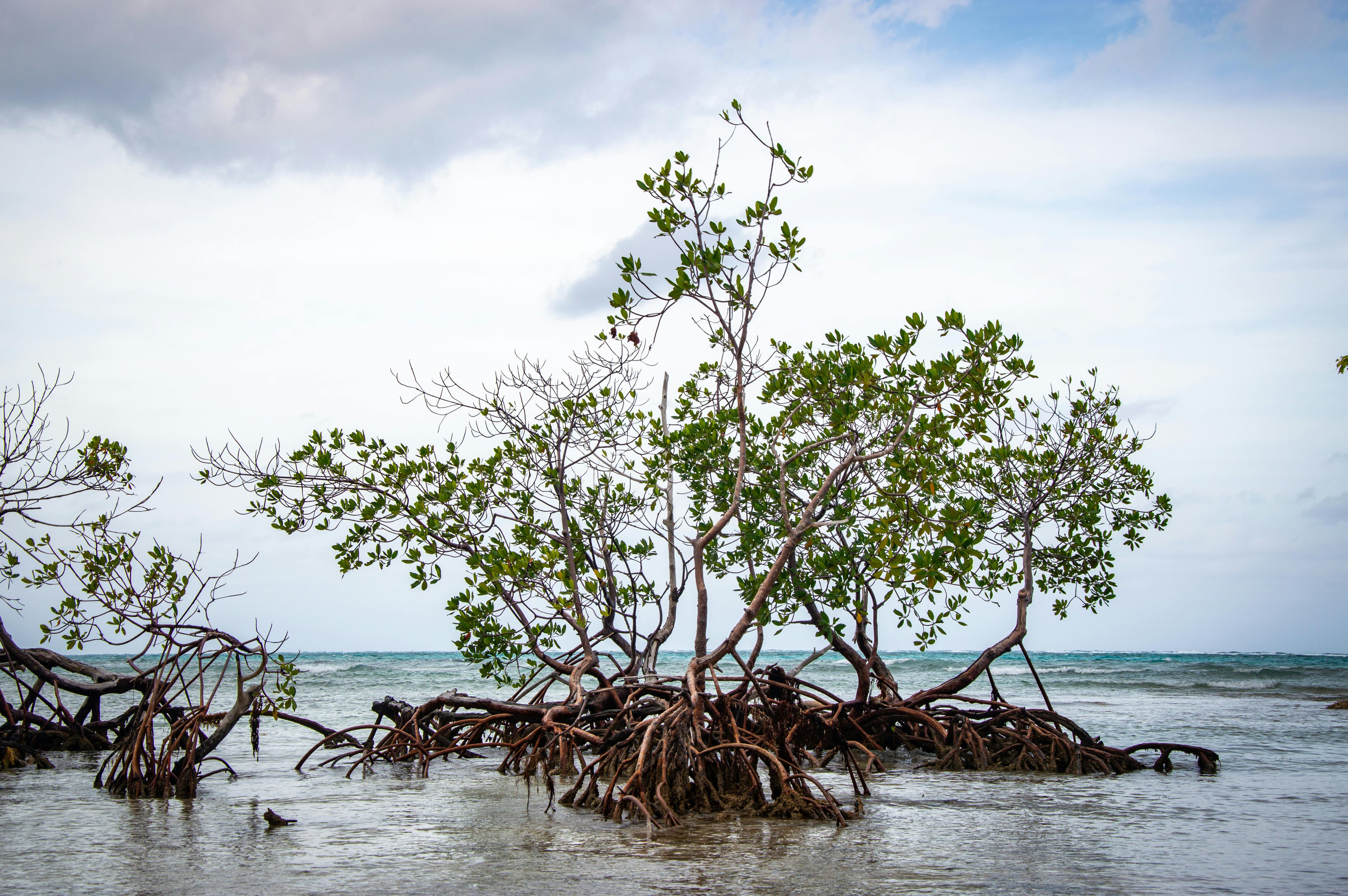
Often I find in my practice that I set out to tell one story, and end up telling another.
This is the case with this essay.
I started writing an essay about time management but for some reason as I started I was called to write on something completely different. Most times I will find my way back to the story I initially intended to tell, but that might not be for weeks or years.
On my father’s side, my family come from a village called Delailasakau in Naitasiri, however, many generations ago my ancestors migrated down to Deuba, Serua and that is where I am written into the Vola ni Kawa Bula (Native title registry). Deuba is made up of many mataqali (tribes) that have migrated from elsewhere. Despite migrating generations ago, my family still maintain strong links to our Naitasiri and Namosi kin.
Although my grandmother moved from her village to Deuba to live on her husband’s land, our family home has always been the stronghold of our matriarch. During her life and beyond her death it remains Bubu’s house.
I guess I will get to writing about the construct of time management at some point, but today, in this essay, I am writing about the ‘Seismic’ in Seismic Temporal and lessons that creatives can learn from mangroves about collaborative, communal storytelling.
But before I get to the mangroves, in true ailan style talanoa - I have to zoom out and begin with the ecosystems that mangroves exist in.
What is a Delta?
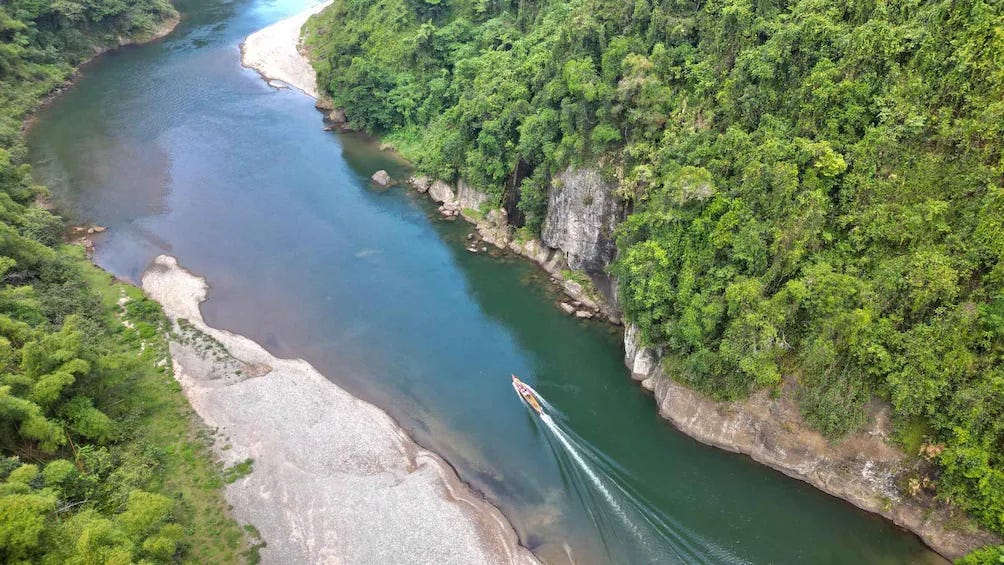
A delta is a landform created by the deposition of sediment that is carried by a river as the flow leaves its mouth and enters slower-moving or standing water. My Bubu’s house sits on the Navua River, not far from where it meets the open sea. I have many photos from across my lifetime of myself and family members swimming in the river, fishing in the ricer and sitting on the riverbank watching the world.
To the right is Beqa and to the left the river leads up towards Namosi’s mountains. The Navua River, which is the third largest river in Viti Levu, is part of the Navua Delta, which is a high-energy delta.
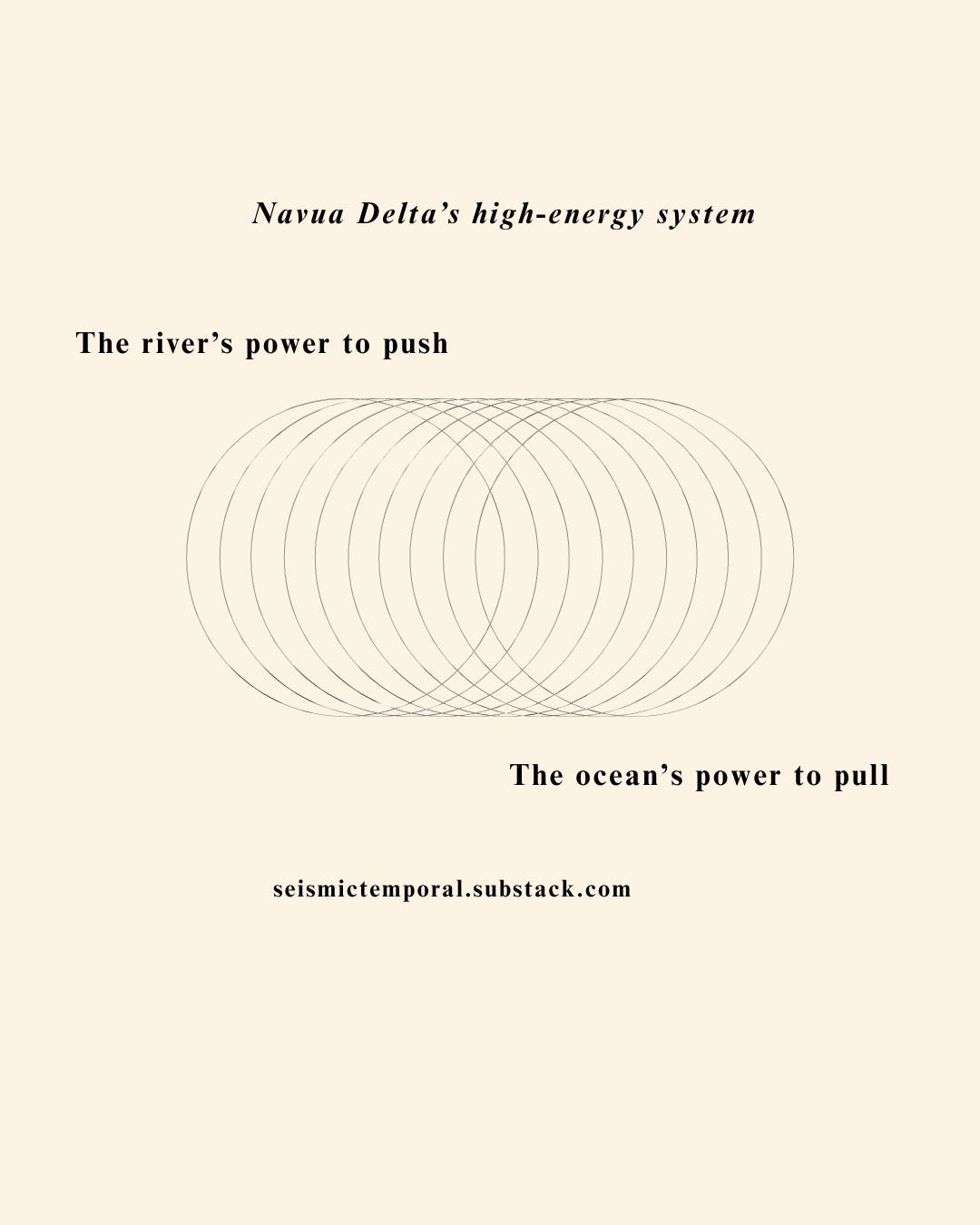
In geography, a delta’s “energy” is determined by the struggle between the river’s power to push and the ocean’s power to pull. The Navua is a high-energy system because neither side is willing to back down. As a proud and strong headed Aries I relate to the high-energy nature of the Navua Delta that spreads across the Serua and Namosi provinces (my parents are also both fire signs, so you can imagine how loud and chaotic my house was growing up).
As a fire sign, I have been fascinated with volcanoes for as long as I can remember, and as I have gotten my older my curiosity has increased - especially since living and working in Aotearoa. I am amazed by the incalculable power they wield, and how quickly an eruption reminds us that humans really aren’t in control of this world. One of my favourite pastimes is looking at the rich red volcanic qele of Namosi on the way to Suva from Deuba. Ni-Vanuatu poet and politician Grace Mera Molisa’s iconic ‘Black Stone’ has had a resounding influence on my worldview and creativity, for which I am ever grateful and Selina Tusitala Marsh’s essay about her work in Cordite Poetry Review provided excellent context that I devoured as a young and fresh drama school graduate.
A favourite memory I have of arriving in Aotearoa was actor, playwright and director Tawhi Thomas, telling me in our office one afternoon about earthquakes in Aotearoa after we experienced a large one the night before. In Te Awa Kairangi, there is a fault line that runs right down the motorway leading to the Te Whanganui-a-Tara (Wellington). Tawhi told me about Rūaumoko, an Ātua in Te Āo Māori who is custodian of earthquakes and volcanoes and the unborn child of Papatuānuku, the Earth mother. I was 7 months pregnant, at the time and I vividly remember Tawhi smiling and saying “Yep, that earthquake was just baby Rūaumoko moving around in Māmā Papatuānuku’s belly.”
I remember thinking “Damn, Te Āo Māori knows what’s up” and smiling at the image of a sleepy bubba wriggling around beneath us because we were making too much noise on island.
The Navua Delta
The Navua Delta stretches from the mountainous highlands in Namosi, down through the river to the Navua Plains and out to the open sea. To the west is the coral coast, and to the east is Suva. In Deuba, where the Navua River meets the sea, Dogo and Tiri (mangroves) act as a filtration system for Viti Levu trapping and transforming the heavy volcanic silt and high rainfall runoff from the mountains to protect the Beqa lagoon, one of Fiji’s most vital reef systems.
In simple terms, the Navua Delta is a living system that has been building the Deuba coast for millions of years. Think of it as a giant, ancient sponge made of mud and roots.
The Ecological Stake
Across the South Pacific, mangrove forests sit at the intersection of ecological necessity and escalating risk due to the climate crisis and growing development. Melanesia (Papua New Guinea, Solomon Islands, Fiji and Vanuatu) has both the highest density of mangroves in the region, and most diversity with Papua New Guinea being home to the largest mangrove area in the Pacific and 8th largest in the world. According to a UNESCO report from 2022, 75% of that is held in Papua New Guinea alone, which ranks as the second highest diverse mangrove population in the world with 43 unique species. Following Melanesia, Micronesia is home to the next largest Mangrove population with a high biodiversity of over 10 species in it’s high mountainous areas and low-lying atolls.
In Fiji’s Navua Delta, these intertidal forests underpin marine food webs, providing shelter and breeding grounds for species ranging from invertebrates to sharks. Beyond their biological role, they are among the planet’s most efficient natural systems for long-term carbon storage, outperforming many land-based forests. As a result, Navua’s mangroves represent a powerful, nature-based resistance to climate change.
While an individual mangrove tree might live about 100 years, the deep layers of soil beneath them are thousands of years old, holding onto massive amounts of old carbon and history - I’ll come back to this shortly.
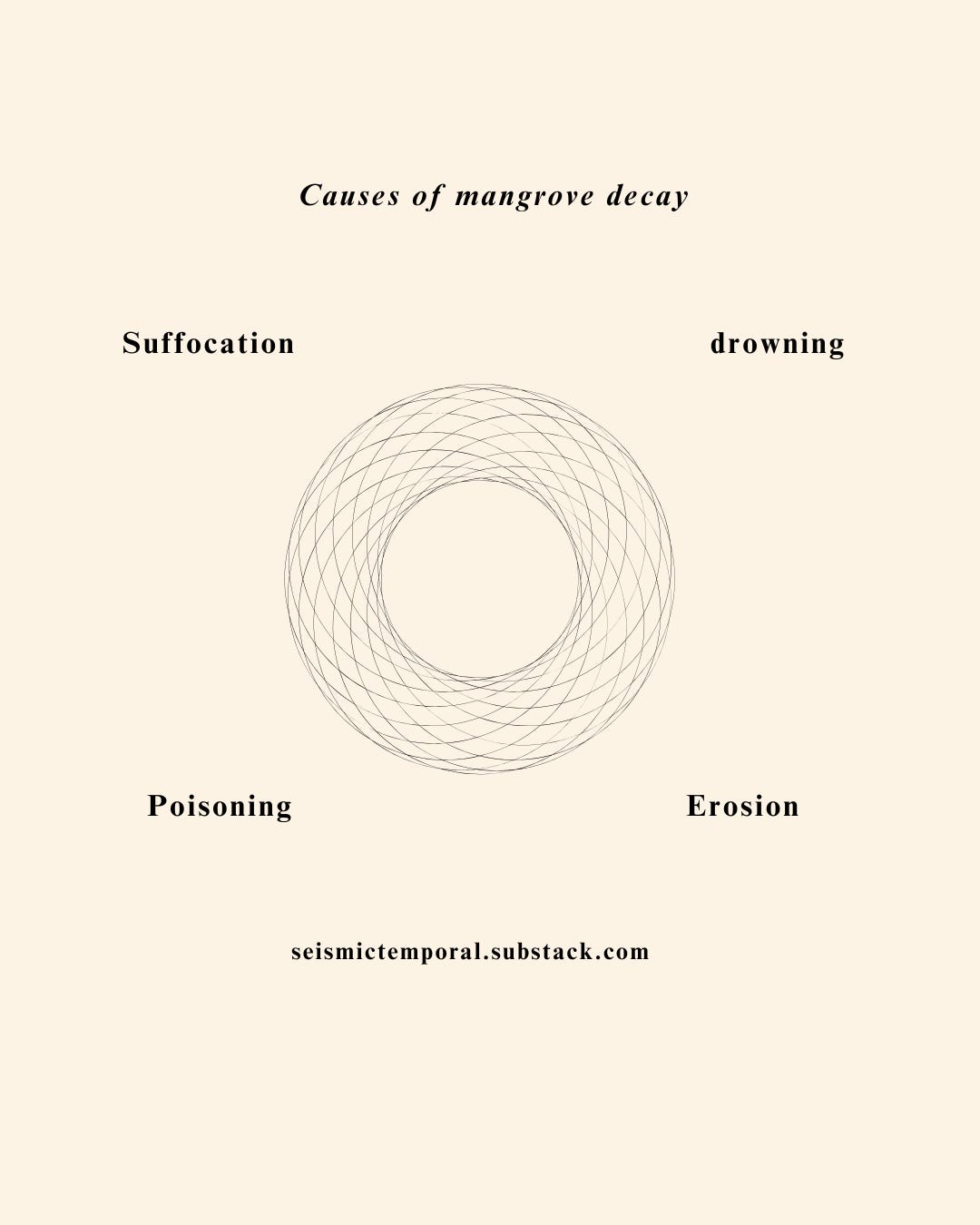
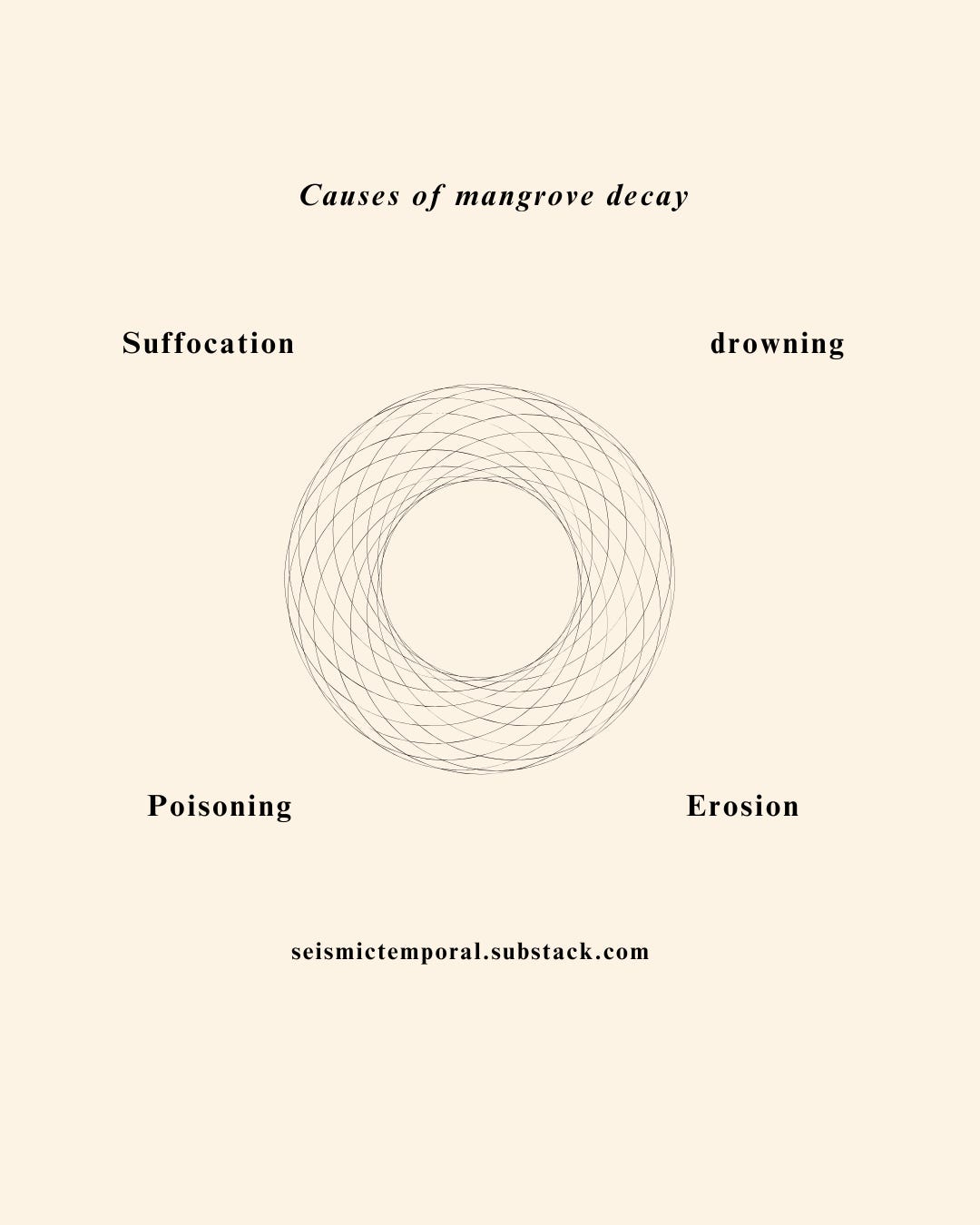
Mangrove decay is caused by four major events:
Suffocation from stagnant water
Drowning from buried roots,
Poisoning from heavy or acidic mud
Erosion from the ocean washing away the ancient soil.
What can the decay of mangroves teach us about creative ecosystems and collaboration?
The decay of mangroves in the Navua Delta teaches us that a creative ecosystem does not fail because of a lack of talent, but because its rhythms of exchange have been interrupted. Just as the Dogo and Tiri forests require a constant flow between the salt of the ocean and the fresh water of the river to survive, a creative collaboration requires a balance between vision and administration.
Decay, like the fungi that emerge from it, is a diagnostic tool; it reveals exactly where the flow has stopped and the “Seismic” pressure has become destructive rather than fertile. In the delta, fungi are the first responders, the “recycling” unit capable of turning the heavy wood of a failed structure back into the soil.
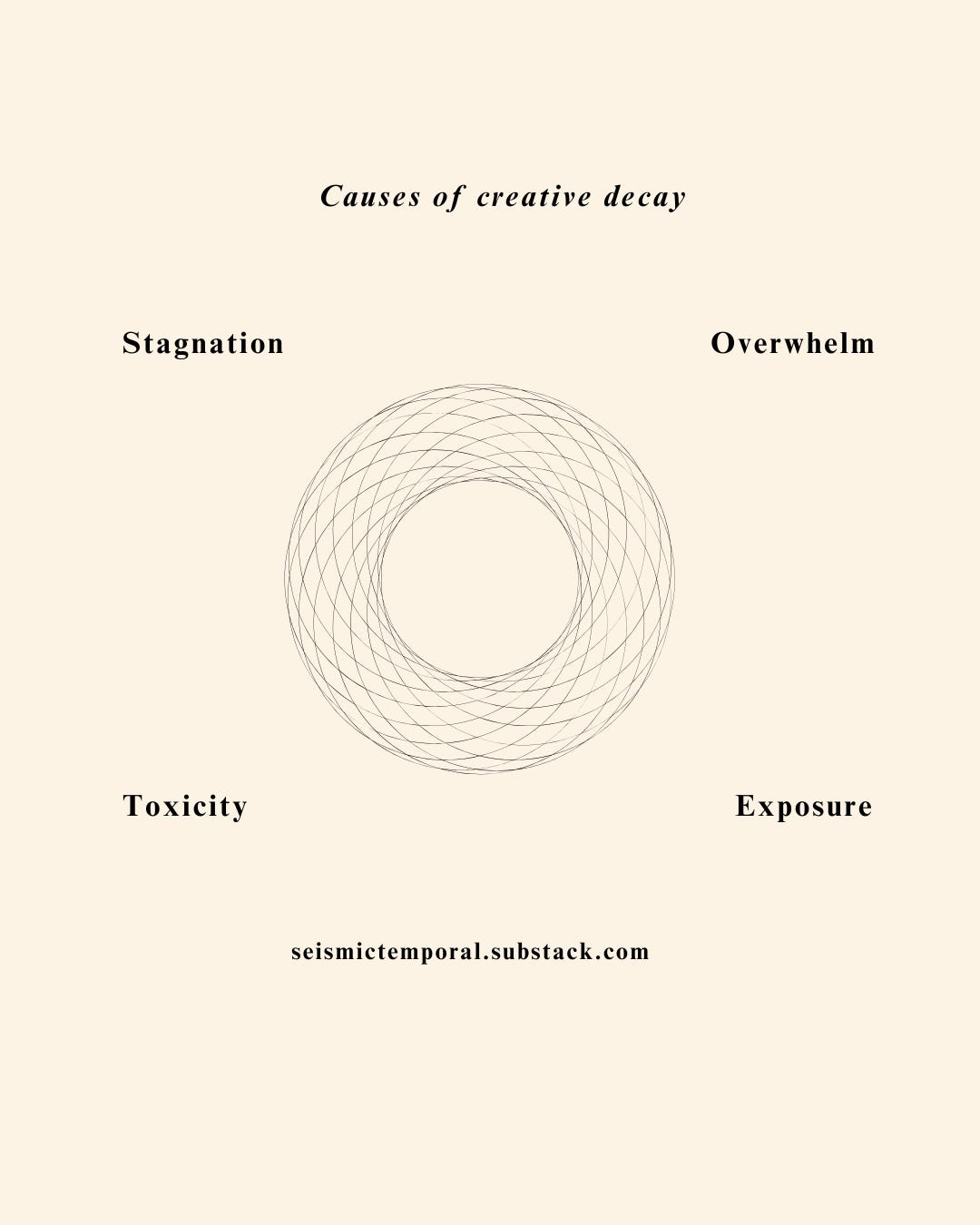
When we look at the four major events of mangrove decay, we see a mirror of the blocks that stall our most vital collaborations:
Suffocation - Stagnation
Causes: Rigid hierarchy, fixed templates, siloed departments and conversations
Produces: Static narratives. Stories feel assembled, rather than organic. They lack breath because the system has filtered out challenging, nuanced new perspectives.
Drowning - Overwhelm
Causes: Too many tasks with a lack of time and resources
Produces: Cluttered narratives. The core intention and message of a story is either smothered by noise or lost altogether, leaving audiences with an unfocused experience.
Poisoning - Toxicity
Causes: Extractive funding models, misaligned KPI’s, colonial frameworks, relational boundary bleeds
Produces: Reactionary narratives. What serves the story is discarded for work that is thin on values.
Erosion - Exposure
Causes: Removal of values, lack of storytelling with integrity, demanding access to your work without providing protection
Impact: Fragile narratives. Without values grounded in Indigenous relations and responsibilities, stories are performative and extractive.
This is where we return to the thousand-year soil I mentioned earlier. In the Navua Delta, the ‘success’ of the forest is measured in it’s Peat - the deep, compressed soil archive of everything that came before.
In a storytelling context, this soil is our Deep Time foundation; it is the accumulated weight of our lineage, and the stories that have been settling for generations. The term Deep Time was coined by US-American author John McPhee, referring to the limits of human imagination in the face of geological time through his non-fiction book Basin and Range. Academic Stephen Jay Gould then popularised this term in his book ‘Time’s Arrow, Time’s Cycle. Myth and Metaphor in the Discovery of Geological Time. Key to this worldview of Deep Time is the insistence that history is shaped by many non-human actors and forces. In the context of so-called Australia, Deep Time history has become a vehicle for sharing 65,000 years of First Nations knowledge.
For Dogo and Tiri, Deep Time is the literal soil they stand on. When we allow systemic decay to take hold of the way we collaborate, we risk the erosion of not only the archive ut ourselves. If we don’t protect our breathing roots from overwhelm or our frontlines from exposure, the ‘high-energy’ currents of the institution will wash away our work and the very ground we stand on. Our responsibility as storytellers is to stand our ground, to ensure that our current silt is allowed to settle and thicken this soil for those who come after us.
In conversation with Arcia Tecun and Kassie Hartendup about imagining elsewhere, Anisha Sankar shares:
“Western epistemology has given rise to capitalism which is based on the opposite of the reciprocity of ubuntu, I can only succeed if you fail, not I can only succeed if you succeed if nature succeeds and nature does…it is based on the success of the few at the expense and the failure of many. (Sankar, p. 28)
In the Navua Delta, mangroves survive in a seismic, chaotic space only because they are a cooperative network. No single tree can withstand a high-energy storm or a river flood alone. They rely on the root-intertwining networks that hold the earth together and the fungal systems that turn fallen wood back into nutrients. Success is a shared state of ecological integrity.
To be a storyteller in this landscape is to protect that integrity. It is the commitment to ensuring that when a project faces stagnation or overwhelm, we do not let the decay become terminal. Like the mangrove forest, we must cultivate the internal networks that allow us to recycle our failures into the thousand-year soil. By doing so, we ensure that our stories are not just temporary structures, but part of a living, deep-time archive that continues to build the coast for those who come after us.
Support my work
If you learnt something new, and believe in this work you can support me by buying me a cuppa tea. Click the button below to support my work.
References
Sankar, Anisha, Arcia Tecun, and Kassie Hartendorp. “Imagining Elsewhere: A Critically Romanticized Conversation on Indigenous Futures.” Whose Futures?, Economic and Social Research Aotearoa (ESRA), 2020
“Deep Time.” ABC News, Australian Broadcasting Corporation, 2024, https://www.abc.net.au/news/deeptime/.
“Deep Time.” Department of Germanic Languages and Literatures, The Ohio State University, 2024, https://germanic.osu.edu/deep-time.
Donato, Daniel C., et al. “Mangroves among the Most Carbon-Rich Forests in the Tropics.” Nature Geoscience, vol. 4, no. 5, 2011, pp. 293-97, https://www.nature.com/articles/ngeo1123.
Fox, J. P., and I. T. Twyford. The Soils of the Navua Plains and Their Chemical Status. Fiji Department of Agriculture, 1954. Fiji Soil Prediction Project, https://fiji-psp.landcareresearch.co.nz/assets/soil-reports/Fox-Twyford_1954.pdf.
“Mangroves in Fiji.” Mangroves for Fiji, 2024, https://www.mangrovesforfiji.com/mangroves/mangroves-in-fiji/.
“Navua River Delta.” Important Shark and Ray Areas (ISRA), 2024, https://sharkrayareas.org/portfolio-item/navua-river-delta-isra/.
Secretariat of the Pacific Regional Environment Programme (SPREP). “Status Report on Pacific Island Mangroves.” SPREP Library, 2025, https://library.sprep.org/content/status-report-pacific-island-mangroves.
UNESCO. Mangrove Ecosystems of Papua New Guinea: Coverage and Significance. UNESCO Digital Library, 2022, https://unesdoc.unesco.org/ark:/48223/pf0000382220.